Choosing the right crude oil pump manufacturer affects every year of operation that follows. A good supplier understands your fluid, tests against real conditions and supports the unit after delivery. A weak one ships a catalogue model and leaves you to solve the problems. This guide gives you a practical framework for making that decision.
Look Beyond the Product Catalogue
Many factories can build a pump. Far fewer can explain how viscosity, gas fraction and sand content change the duty point. A credible crude oil pump manufacturer will ask for fluid data before quoting. They will also describe limitations, not just advantages. If a supplier promises that one model suits every crude, treat that as a warning sign.
Engineering Capability to Verify
Custom Design and Simulation
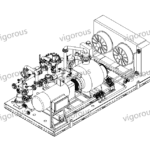
Check whether the factory has an engineering team that can size rotors, select materials and model suction conditions. Custom skid work is a strong signal of real capability. Vigorous Pump, for example, has delivered parallel multiphase skids built around a specific oilfield duty.
Material and Seal Expertise
Crude oil can contain sulfur, water and abrasive solids. Ask which grades are standard, which are optional and what sealing arrangements are available. Reference to recognised practice, such as API standards, is a useful baseline.
Testing and Quality Control
A responsible crude oil pump manufacturer performs hydrostatic tests, performance runs and vibration checks before shipment. Ask for test reports tied to your serial number. In addition, confirm that the factory can trace material certificates to the heat or batch used in your unit. Our ISO certification overview explains how documented quality systems support consistent output.
- Factory acceptance test: witnessed or recorded with your approval.
- Performance data: measured with a fluid close to your real viscosity.
- Documentation: drawings, manuals, spare parts list and certificates.
After-Sales Support and Spare Parts
Even a well-built pump needs seals, bearings and occasional liner replacement. Ask about spare parts stock, response time and remote troubleshooting. A supplier who can ship critical parts quickly will save you far more than a small discount on the purchase price.
Questions to Ask Before You Order
- Which fluid data did you use to size this pump?
- What is the expected life of seals and rotors in my duty?
- Can you provide references from similar oilfield projects?
- How fast can you deliver spare parts to my site?
Moreover, compare total cost of ownership rather than the quoted price alone. Efficiency, reliability and service response often matter more than the initial number.
Why Buyers Work With Vigorous Pump
Vigorous Pump focuses on twin screw and multiphase solutions for crude oil, heavy oil and gas-liquid mixtures. Our teams have supplied units for Shengli and Xinjiang fields, and we support customers from selection through commissioning. You can explore our crude oil transfer pump guide and twin screw crude oil pump guide for technical background.
FAQ About Choosing a Crude Oil Pump Manufacturer
Should I buy directly from the factory?
Factory-direct sourcing improves communication on custom duties, but you should still verify engineering depth, testing and export experience.
What documents should I request?
Ask for the data sheet, general arrangement drawing, test report, material certificates and a recommended spare parts list.
Talk to an Experienced Crude Oil Pump Manufacturer
Send your fluid properties, flow and pressure requirements to Vigorous Pump. Our engineers will recommend a configuration and provide a clear, test-backed proposal. Contact us today to discuss your crude oil transfer project.